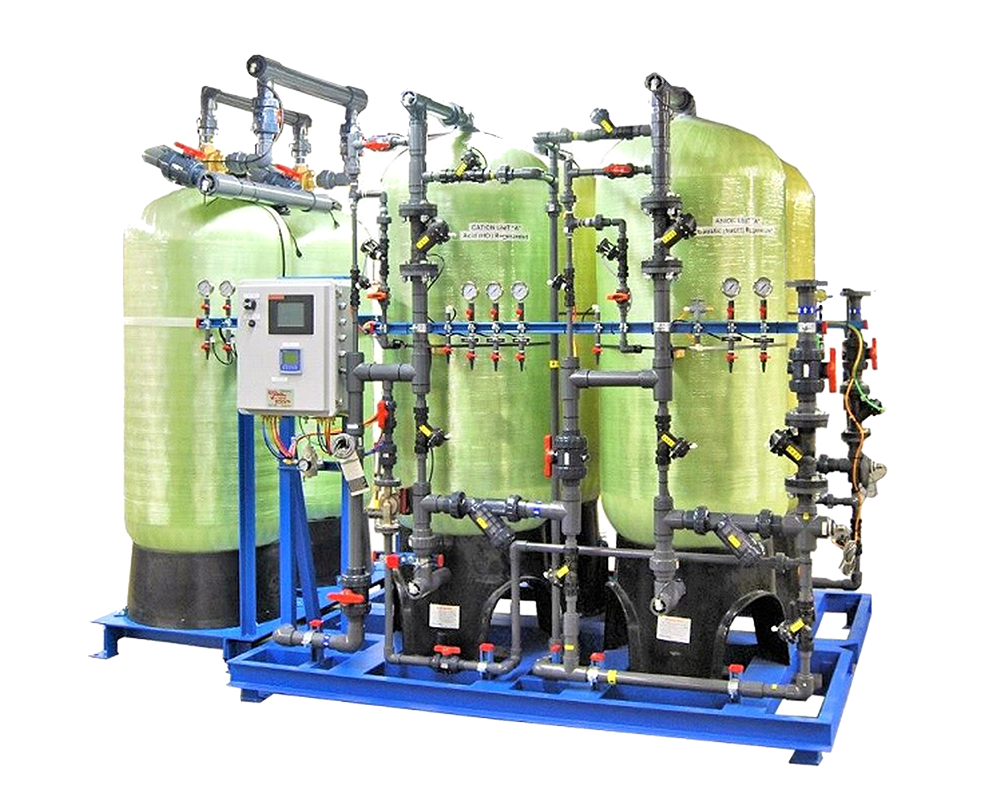
Deionization Systems (DI and EDI)
DI, mixed-bed and EDI systems for ultrapure water after RO, engineered for target resistivity and process duty.
Product Description
Ultrapure water systems are selected by target resistivity and feed quality, and DSTC builds DI or EDI trains around the purity level the process requires. The system may be a mixed-bed DI unit, a two-bed DI system, a continuous EDI skid, or a complete RO-then-EDI train. DSTC sizes the solution to your required m3/day, target resistivity, feed quality and chemical-handling preference, then supplies the vessels, resin or EDI modules, instruments, conductivity or resistivity monitoring, controls and after-sales support.
For quotation, send the feed water analysis, required capacity in m3/day, target resistivity or purity, whether you prefer DI or continuous EDI, whether RO is already installed, available power and delivery city.
Overview
Deionization is used when ordinary filtration, softening and RO are not enough. The target is very low conductivity or high resistivity water for laboratories, high-pressure boilers, electronics and pharmaceutical production. DI systems use cation and anion resin in separate beds or mixed together, and are regenerated with acid and caustic. EDI removes ions continuously using an electrical field, ion-exchange membranes and resin, which reduces chemical handling but requires good RO permeate as feed. DSTC helps decide whether DI or EDI fits the project based on flow, target purity, existing RO and site operation.
Applications
- •Laboratory and analytical ultrapure water for testing, reagents and equipment feed
- •High-pressure boiler make-up water in power plants and steam systems
- •Electronics and semiconductor rinse and process water requiring high resistivity
- •Pharmaceutical and life-science process water where ion levels must be very low
- •RO permeate polishing to lift product water toward 18 MOhm-cm
- •Final ion removal for process and product water in factories needing demineralized water
Product Range & Specs
- ✓Process: DI by cation and anion ion-exchange resin in two-bed or mixed-bed form regenerated with acid and caustic, or EDI for continuous deionization without regeneration chemicals
- ✓Components: FRP or lined pressure vessels, mixed-bed ion-exchange resin available on request, EDI modules, and interconnecting pipework and instruments
- ✓Controls: instruments and controls with resistivity or conductivity monitoring, supplied as a packaged skid or a complete RO-then-EDI train
- ✓Capacity: engineered and sized to your required flow in m3/day, not a single fixed stock model
- ✓Product water: high resistivity up to about 18 MOhm-cm when placed after RO, set by target purity and feed quality
- ✓DSTC support: DSTC sizes the unit to flow and target resistivity, selects DI or EDI, specifies vessels, resin and modules, and delivers across Saudi Arabia
Product Summary
Deionization removes dissolved ions to produce ultrapure water. DI uses ion-exchange resin that is regenerated chemically, while EDI uses electricity and ion-exchange media for continuous deionization, usually after RO, reaching up to about 18 MOhm-cm depending on feed quality.
Frequently Asked Questions
What is the difference between DI and EDI?+
DI uses cation and anion ion-exchange resin that must be regenerated with acid and caustic once exhausted. EDI performs continuous deionization using an electric field and does not need regeneration chemicals.
How pure is the water from a DI or EDI system?+
When installed after RO, DI or EDI systems can produce high-resistivity ultrapure water up to about 18 MOhm-cm. The exact result depends on RO permeate quality, system design and target purity.
Do I need RO before the DI or EDI stage?+
In most cases yes. RO removes the bulk dissolved solids first, so DI or EDI only polishes the permeate and reaches high resistivity efficiently.
What do you need to size and quote a system?+
Send the required capacity in m3/day, target resistivity or purity, feed water analysis and whether RO is already installed. These are engineered systems, so DSTC sizes each one to the flow and target.
Do you deliver DI and EDI systems across Saudi Arabia?+
Yes. DSTC builds and delivers DI and EDI systems across Saudi Arabia, including Jeddah, Riyadh, Dammam, Jubail and Yanbu, for laboratories, power plants, electronics, pharmaceutical and boiler make-up water.